How to budget roofing call coverage when volume changes
Use your own quiet-month and peak-month call logs to plan for the subscription allowance—not a guess about the next storm.
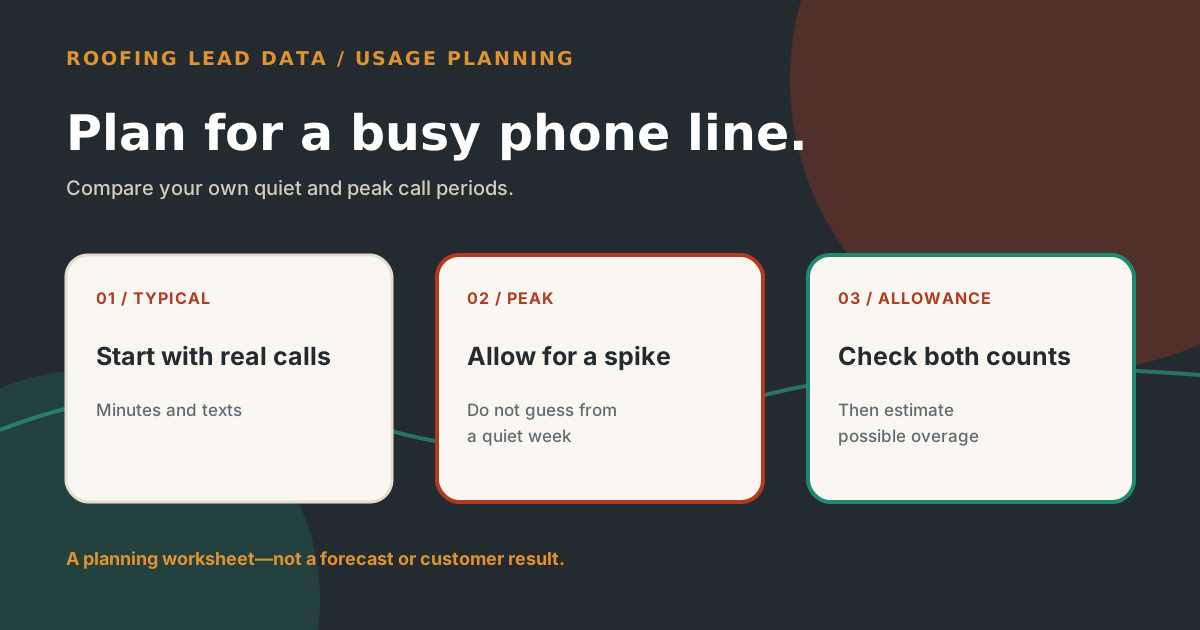
A roofing office may have a steady run of inspection and existing-job calls, then a busy stretch after bad weather. If you budget an AI phone agent using only a quiet week, the next bill can be a surprise. Start with the calls your business actually receives, then compare a normal billing period with a busy one.
Roofing Lead Data's standard AI Phone Agent subscription is $299 per month, month to month. Each billing period includes 500 inbound minutes and 500 SMS. Usage above those allowances is billed at $0.20 per additional minute and $0.04 per additional SMS. These are the current published phone-service terms, not a forecast of what your crew will use.
Start with your own call records
Pull a recent quiet billing period and a recent busy period if you have them. For each, note the number of inbound calls, the actual or estimated minutes handled, and the SMS volume you expect to use. If you only have a call count, multiply it by a reasonable average duration from a sample of your own calls. Keep the estimate clearly labelled until actual usage is available.
- Normal period: What does the line handle when crews are working and weather is ordinary?
- Peak period: What happened during your busiest recent weather or campaign-driven stretch?
- Call mix: Did longer existing-job questions use more minutes than short new-inspection requests?
- Text use: How many SMS messages did the business actually send or expect under its configured flow?
The new-inspection versus existing-job guide helps separate those two kinds of calls. The cost worksheet is different: it estimates how much usage a month might contain, without promising a certain number of booked inspections or saved jobs.
Use a simple allowance calculation
For planning, subtract 500 from your estimated inbound minutes and from your estimated SMS count. Treat any negative result as zero. Multiply excess minutes by $0.20 and excess SMS by $0.04, then add both amounts to the $299 base. Actual billing uses measured usage in your billing period; this arithmetic is only a planning estimate.
| Example period | Inbound minutes | SMS | Illustrative base plus overage |
|---|---|---|---|
| Typical month | 360 | 300 | $299; both counts stay within the included allowances |
| Busy month | 720 | 650 | $299 + (220 × $0.20) + (150 × $0.04) = $349 |
Those numbers are deliberately made up to show the calculation. They do not describe a Roofing Lead Data customer, a storm forecast, or a guarantee about call length. Your actual usage may be higher or lower.
Budget the busy period, then review the first real one
Use a range rather than a single “average month” number. A few longer conversations can change minute usage, and a text-heavy follow-up plan can change SMS usage. Ask during sales-assisted setup how your approved greeting, intake questions, inspection path, and human handoff will work. Do not shorten a useful caller conversation merely to hit an estimate; adjust the plan with your team when measured usage shows a real pattern.
The service has no setup or onboarding fee. You can make later changes in the platform, with support available if you need additional help. To prevent the next monthly renewal, cancel before the current billing period ends; service remains available through the paid period, and overages already incurred remain due. Read the full terms before purchasing.
Bring the right questions to the call-flow conversation
Bring two sets of call-volume notes and the questions your team wants answered. Then review the published service and price or talk through your roofing call flow. The useful decision is not whether you can predict the next storm; it is whether your team understands the allowance, the overage math, and who will review actual usage after launch.