New inspection request or existing-job question?
Treating an existing customer like a stranger hurts job trust, while missing a new inspection request loses revenue—here is how roofing offices cleanly branch the two paths.
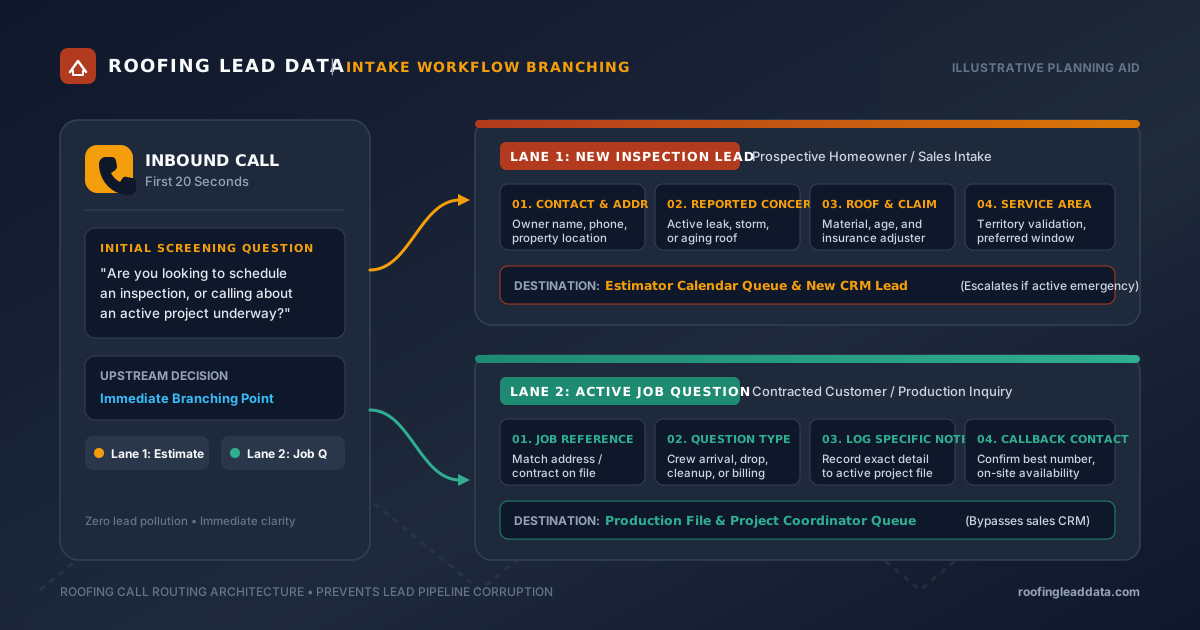
When an inbound phone rings at a roofing company, the caller is almost always in one of two very different situations:
- A homeowner with a damaged or aging roof who needs an inspection, an estimate, or storm assessment.
- A current customer whose job is already under contract or underway, asking when the crew arrives, when shingles are being dropped, or whether a supervisor can check a flashing detail.
Both callers need prompt attention, but they require completely different treatment. If your front office or call handler treats an active customer like a stranger—asking them for their address from scratch, inquiring whether they own the home, and pushing them into a sales pipeline—the homeowner feels ignored and worries about their project. On the flip side, if an unorganized call desk assumes an urgent leak call is just an existing customer follow-up, a high-value new roof replacement inquiry can languish in a general voicemail box while another roofer down the street books the inspection.
The buyer decision for roofing contractors is straightforward: establish an early, unambiguous branch in your phone flow between new inspection leads and active job inquiries, collect only the context relevant to that specific path, and route each call to its proper operational destination.
Here is how roofing offices set up that branching decision, what information belongs in each lane, when an inspection request moves to scheduling or a person, and how to keep current project updates from cluttering your sales queue.
1. Establish the branching point in the first twenty seconds
A roofing call should never drift through several minutes of conversation before the desk realizes what kind of call it is. The first question after a professional greeting should establish the caller’s status immediately:
“Thanks for calling [Company Name]. Are you calling to schedule a roof inspection or estimate on a property, or are you calling about an active project we're currently working on?”
This single prompt splits the call into two distinct operational lanes:
- Lane A (New Inspection Inquiry): The homeowner needs an assessment, quote, or storm damage review. The objective is to qualify property ownership, location, roof issue, and availability, then guide them toward an inspection appointment or estimator review.
- Lane B (Active Project Question): The homeowner already signed a contract or work has commenced. The objective is to identify the job location or project name, record their specific question, and connect them with production management or their assigned project coordinator without creating duplicate lead records.
By asking this question up front, the caller feels heard immediately, and the person or system handling the phone knows exactly which intake script to follow.
2. Lane A: What context the office asks on a new inspection request
When a caller confirms they need an inspection or quote, they have entered your sales intake pipeline. The goal is not to sell the job over the phone or provide an uninspected phone quote; the goal is to capture the practical details an estimator needs before driving out to the property.
As detailed in our guide on what to capture on a roofing inspection call, the office should gather five core categories of information:
- Caller identification & property address: Full name, mobile phone number, email address, and the physical address of the roof that needs inspection.
- The nature of the reported concern: What prompted the call? Is there active water penetration or an interior ceiling stain? Is it hail or wind damage from a recent storm, missing shingles, or simply an older roof needing routine replacement?
- Roof characteristics (if known): Approximate roof age, shingle or roofing material type (asphalt architectural, metal, tile, flat membrane), and stories (single-story vs. steep multi-story). Homeowners may not know every technical detail, but basic notes help estimators prepare the right ladder equipment.
- Insurance context: Is the caller filing an insurance claim for storm damage, working with an adjuster, or paying directly? Knowing whether an adjuster meeting has already been scheduled helps the office coordinate calendar timing.
- Service-area and scheduling preference: Confirming the home is within the contractor’s primary service territory, followed by their preferred inspection days and morning or afternoon windows.
Collecting this structured context ensures the estimator arrives with clear background notes rather than walking onto the property blind.
3. When an inspection request moves to human review or approved scheduling
Not every inspection request follows the exact same path. Once the basic details are collected, the call flow must decide whether the call can move directly to an approved scheduling process or requires immediate human review.
Path 1: Moving to an approved scheduling path
An incoming request can smoothly advance to calendar booking or standard dispatch when it meets your company's core criteria:
- The address is within your defined service area.
- The caller is the homeowner or authorized decision-maker.
- The inquiry is a standard residential inspection or replacement evaluation.
- The requested timeframe aligns with regular estimator availability.
In these standard cases, the call can offer an available inspection window or confirm that an estimator will review the calendar and confirm the slot.
Path 2: Escalating to a human team member
Certain inspection requests should not be placed on standard scheduling queues. The call flow should branch to an immediate human handoff or priority notification under specific operational triggers:
- Active interior flooding or structural emergency: A severe leak actively destroying drywall or ceilings requires immediate mitigation dispatch or tarping triage rather than a standard two-week estimate slot.
- High-value commercial or multi-family properties: Multi-unit complexes, churches, or commercial flat roofs require commercial sales specialists rather than residential field estimators.
- Complex insurance adjuster meetings happening today or tomorrow: If an adjuster is already scheduled on the roof within 24 hours, the contractor needs immediate human notice to dispatch a representative.
- Outside regular service boundaries: If a caller is slightly outside your primary territory, a contractor or sales manager must decide whether the job size justifies travel time before booking a slot.
By separating standard inspection scheduling from high-priority human escalation, your team protects both its calendar efficiency and its high-urgency responsiveness.
4. Lane B: What context the office asks on an existing-job question
When a caller indicates they have an active project underway, their questions revolve around project execution, crew logistics, or administrative coordination. Putting this caller into a sales form creates confusion.
Instead, Lane B gathers project-specific operational context:
- Project reference: The property address where work is scheduled, or the primary homeowner/contract name on the project agreement.
- The specific category of the inquiry:
- Schedule & crew arrival: “What time is the tear-off crew showing up tomorrow?”
- Material delivery: “When are the shingle pallets being dropped in my driveway?”
- In-progress observation or cleanup: “A piece of siding looks loose near the dormer,” or “Can the crew run the magnetic nail sweep around the dog run again?”
- Change orders & scope adjustments: Inquiries regarding rotted decking discovered during tear-off or adding gutter guards.
- Billing & insurance paperwork: Invoices, supplement documentation, completion certificates, or deductible payment questions.
- Preferred callback contact: Confirming the best number and whether the caller will be at the property today.
This information is logged directly to the active job record. The caller is given clear expectation management—such as confirming that the project manager or production supervisor will review the job file and follow up.
5. How to prevent existing jobs from polluting your new lead pipeline
One of the costliest workflow breakdowns in roofing contractor offices occurs when existing customers are mistakenly logged as new inbound leads. When that happens:
- Sales metrics become distorted: Your CRM reports inflated lead counts, creating false conversion rates and distorted marketing ROI figures.
- Sales reps waste time on non-sales calls: An outside sales representative calls the homeowner expecting a sales discovery conversation, only to find the customer is asking why the dumpster hasn't been picked up yet.
- Homeowners lose confidence: The customer wonders why a company that already took a deposit has no record of their active roof installation.
Three rules to keep job updates separate from new leads
- Cross-reference existing records before creating an inquiry: Before an intake file is marked as a new sales prospect, check the address and phone number against active production files. If the property address matches an open contract, attach the notes to the existing job file instead of opening a new deal.
- Route directly to production or project management: Route existing job inquiries to production coordinators, field superintendents, or the dedicated customer service desk—never to commission-driven sales estimators who do not manage daily crew schedules.
- Use distinct notification tags: Ensure call summaries or notifications for existing customers carry clear operational badges (e.g.,
[ACTIVE JOB - PRODUCTION INQUIRY]) rather than[NEW INSPECTION LEAD]. This visual cue tells the office team at a glance how to handle the message.
6. Two-lane roofing call intake and routing worksheet
Use this labelled planning worksheet to configure your office staff, answering desk, or inbound call workflows:
| Call Attribute | Lane 1: New Inspection Lead | Lane 2: Active Job Question |
|---|---|---|
| Screening question | “Are you looking to schedule an inspection or estimate on a property?” | “Are you calling about an active project or contract currently underway?” |
| Primary objective | Qualify the property, reported issue, and book an estimator inspection. | Identify the active job, capture the specific production question, and alert the crew coordinator. |
| Context gathered | • Property address • Caller contact details • Damage type / reported issue • Roof age / material (if known) • Insurance claim status • Preferred scheduling window |
• Property address / Contract name • Caller contact details • Question category (crew timing, materials, cleanup, invoice, change order) • Specific message details • Availability on site |
| Standard destination | Estimator calendar queue or new lead CRM record. | Production file / project manager task queue. |
| Human escalation triggers | • Active water pouring / structural emergency • Large commercial / multi-family property • Imminent adjuster meeting within 24 hours • Out-of-territory discretion |
• Active job-site safety issue or crew property concern • Unplanned water entry during mid-project tear-off • Caller requesting immediate stop-work |
| What to strictly avoid | Quoting prices over the phone without seeing the roof. | Creating a duplicate new sales lead in the CRM or asking basic qualifying questions already on file. |
This worksheet is an illustrative planning aid designed to help contractors structure call flows; specific fields and routing paths should be tailored to each business's operational guidelines.
7. An illustrative scenario: How two calls branch on a rainy Tuesday
To see how this distinction functions during everyday operations, consider how a roofing company handles two back-to-back phone calls while crews are out in the field:
Illustrative Example
A residential roofing contractor in Fort Worth, Texas, experiences steady spring rain. The office line receives two calls within ten minutes:
- Call 1 (New Lead): Homeowner Sarah calls reporting water dripping through a ceiling fan in her upstairs hallway following high winds two nights prior. The intake screening identifies her as a new caller. The desk captures her property address, confirms she owns the single-family home within their standard service county, notes the asphalt shingle roof is approximately 18 years old, and confirms she plans to contact her insurance carrier. Because water is actively dripping into living space, the flow flags the call for rapid contractor review rather than standard next-week booking.
- Call 2 (Active Job): Homeowner David calls from an address where a complete roof replacement is scheduled for Thursday. He wants to know if the shingle supplier will drop pallets onto his driveway on Wednesday afternoon so he can move his RV. The screening immediately branches to Lane 2. The intake confirms his address against the active job schedule, logs his delivery timing question directly into the production note queue, and routes a notification to the production manager. David is never asked to re-explain who he is or what roof he wants; his question reaches the person coordinating material drops.
This scenario is an illustrative example designed to demonstrate workflow planning; it does not represent an actual customer endorsement or specific transaction.
8. Putting the two-lane flow into practice
Establishing clean call routing does not require complicated phone menus. It requires discipline around how calls are greeted, how questions are branched, and where notes are deposited.
Follow these practical steps to implement the flow in your business:
- Train your front desk on the 20-second screening question: Make sure whoever answers the phone—whether an in-house receptionist, answering service, or inbound AI phone agent—asks the branching question before collecting extensive details.
- Review your service-area and escalation triggers: Clearly define what constitutes an emergency leak or high-value job so call handlers know exactly when to route a caller directly to a supervisor.
- Connect intake to the right tools: Ensure new inspection inquiries route toward your estimator calendars and sales records, while active job questions link directly to your production schedule. For teams looking at field operations, review our roofing call-flow checklist for crews in the field.
- Prepare for weather surges: During hail or storm events, call volume can spike dramatically. Having these two lanes mapped in advance ensures your office can absorb storm inquiries without losing track of ongoing roof replacements already under construction, as outlined in our guide on setting up a storm-call intake path.
Next steps for your roofing call flow
When your phone line knows the difference between a homeowner looking for an estimate and an existing client asking about their crew, your office runs smoother and your customers receive better service.
- Want to explore how automated phone routing works? Learn how Roofing Lead Data answers calls, captures job context, and routes handoffs.
- Have common questions about setup and coverage? Review our Roofing Call Answering FAQ.
- Need a detailed inspection field list? Read what to capture on a roofing inspection call.
- Ready to configure your inbound call flow? Talk through your roofing call intake with Roofing Lead Data or review our standard phone service subscription.