The Roofing Crew Call-Handoff Note: What Field Teams Need
A voice message says someone called; a structured crew handoff note tells an estimator what to expect, where to look, and what questions still need answering before getting on the ladder.
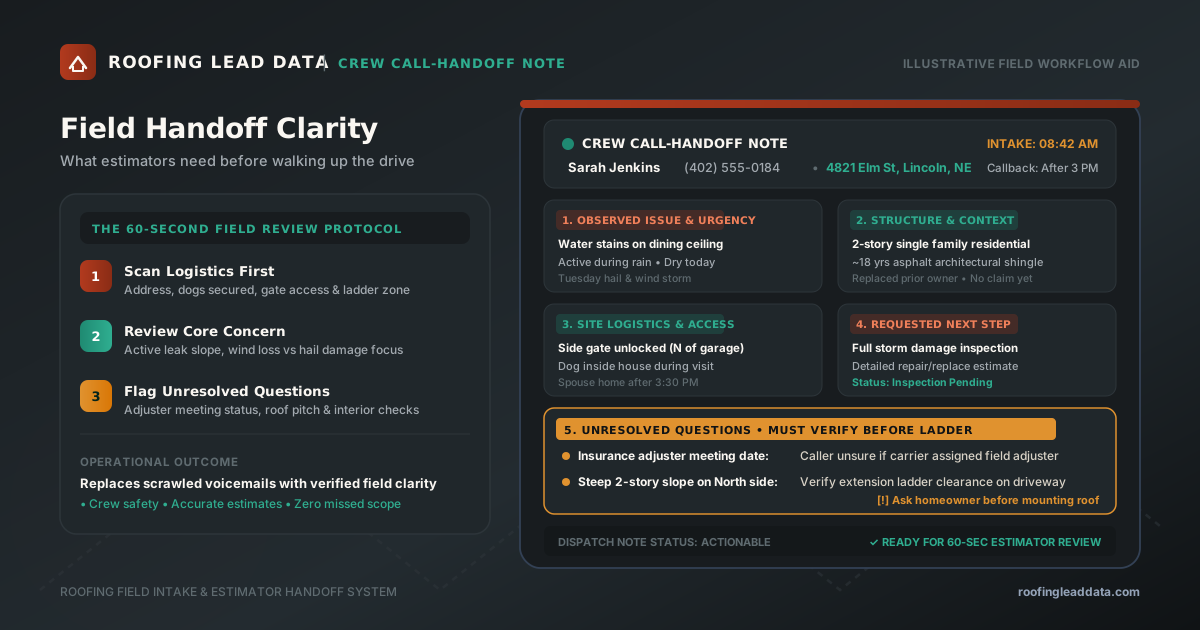
When an estimator or crew foreman pulls up to a curb, they have about sixty seconds to understand the job before walking up the driveway.
If all they received was a scrawled phone number and the phrase “wants an estimate,” they are starting from zero. They do not know whether the homeowner noticed active water in the master bedroom this morning, whether there is a locked gate with dogs in the backyard, or whether the caller is looking for a patch repair versus a full storm replacement.
A productive inbound phone line does not just answer the phone—it produces a structured, actionable crew call-handoff note. By formatting intake into a consistent field summary, your roofing office gives field teams the context they need to walk the perimeter safely, inspect the right slope, and hold a knowledgeable conversation with the homeowner.
The 5 Essential Sections of a Field Handoff Note
A useful field note is not a complete transcript of a ten-minute conversation. It is a filtered, scannable briefing organized around the estimator's workflow.
+-----------------------------------------------------------------------+
|                 ILLUSTRATIVE CREW CALL-HANDOFF NOTE                   |
+-----------------------------------------------------------------------+
| CALL SUMMARY                                                          |
| Caller Name: Sarah Jenkins              Time Captured: 08:42 AM       |
| Primary Phone: (402) 555-0184           Callback Window: After 3:00 PM|
| Property Address: 4821 Elm Street, Lincoln, NE                        |
+-----------------------------------------------------------------------+
| 1. OBSERVED ISSUE & URGENCY                                           |
| - Reported Issue: Water stains on dining room ceiling after storm.    |
| - Urgency Level: Active leak during rain; currently dry today.        |
| - Storm Date / Event: Tuesday hail/wind storm.                        |
+-----------------------------------------------------------------------+
| 2. STRUCTURE & PROPERTY CONTEXT                                       |
| - Property Type: Single-family 2-story residential.                   |
| - Approximate Age: ~18 years; asphalt architectural shingle.          |
| - Prior Work / Claims: Replaced by previous owner; no claim filed yet.|
+-----------------------------------------------------------------------+
| 3. SITE LOGISTICS & ACCESS                                            |
| - Ground Access: Unlocked side gate on north side of garage.          |
| - Pets / Hazards: Dog will be inside the house during inspection.     |
| - Homeowner Presence: Homeowner at work; spouse home after 3:30 PM.   |
+-----------------------------------------------------------------------+
| 4. REQUESTED NEXT STEP                                                |
| - Desired Outcome: Comprehensive storm damage inspection & quote.     |
| - Routing State: Inspection Request (Pending schedule confirmation).  |
+-----------------------------------------------------------------------+
| 5. UNRESOLVED QUESTIONS (MUST VERIFY BEFORE LADDER)                   |
| [!] Insurance adjuster meeting date: Caller unsure if adjuster assigned|
| [!] Steep slope / 2-story ladder requirement: North side has high pitch|
+-----------------------------------------------------------------------+
This worksheet is an illustrative planning aid designed to help contractors structure field call-handoff notes; specific fields and layout should be tailored to each business's operational workflow.
1. Homeowner & Property Identification
The header must establish basic identification without hunting: caller name, direct callback phone number, jobsite physical address, and any specific callback timing window requested by the caller.
2. Observed Issue & Urgency Indicators
Field estimators need to know what prompted the call. Distinguishing between routine aging wear, granular loss, sudden wind shingle blow-off, or active ceiling dripping helps the estimator prioritize their daily route. An active water intrusion requires immediate tarping evaluation; a routine gutter inspection can follow standard scheduling.
3. Structure & Property Context
Knowing whether the building is a single-story ranch, a steep two-story Victorian, or a low-slope commercial roof determines what gear needs to be on the truck. Gathering shingle type and approximate roof age prevents technicians from arriving with the wrong equipment.
4. Site Logistics & Access Boundaries
Nothing burns more billable crew time than arriving at a site only to encounter locked privacy fences, aggressive pets, or neighbors disputing property lines. A standardized intake captures gate access details, permission to walk the grounds, and whether an adult will be present during the inspection.
5. Explicit Unresolved Questions
The most dangerous field note is one that pretends to have all the answers. If the caller did not know their insurance company's claim status, did not know when the roof was installed, or was unsure whether an interior leak extended to the attic, the note must explicitly flag these as Unresolved Questions. This tells the estimator exactly what to ask before stepping on a ladder.
Comparison: Vague Message vs. Actionable Field Note
The difference between a basic phone message and an operational handoff note directly affects close rates and field safety:
| Information Area | Typical Scrawled Voicemail | Structured Crew Handoff Note |
|---|---|---|
| Caller Intent | “Needs an estimate on roof.” | “Inspection request for north-slope wind damage following Tuesday hail storm.” |
| Site Preparation | Address only; no access notes. | “Full address confirmed; side gate unlocked; ladder set-up clear on driveway side.” |
| Urgency Context | Unknown until estimator calls back. | “Non-active leak; water stain dry; wants inspection before weekend rain.” |
| Missing Facts | Assumed complete or ignored. | “Explicitly flagged: Insurance claim status pending; adjuster not yet scheduled.” |
| Crew Action | Technician must re-interview homeowner. | Technician reviews note in 45 seconds, walks property, verifies flagged questions. |
This comparison is an illustrative planning aid designed to help contractors evaluate intake note quality; specific fields and routing paths should be tailored to each business's operational guidelines.
A 60-Second Field Review Protocol
Before setting a ladder or greeting a homeowner, the field lead follows a simple three-step review protocol:
- Scan Logistics First: Check the address, property type, and access hazards. Confirm that dogs are secured and gates are accessible.
- Review the Core Concern: Understand the specific damage the homeowner reported so you can inspect that area first before performing a complete roof evaluation.
- Address the Unresolved Questions: When greeting the homeowner or sending an arrival text, lead with the items flagged as unresolved: “Hello Sarah, I'm here from Roofing Lead Data to check the storm damage on the north slope. Before I get the ladder set up, do you know if your insurance company assigned an adjuster yet?”
Phone Service Alignment and Operating Boundaries
Roofing Lead Data provides a dedicated 24/7 AI phone agent configured around the specific intake paths and routing rules of roofing contractors.
- Subscription & Setup: Under our standard terms, phone service is $199/month (or $299/month for specialized Tier 2 configurations), including 500 inbound voice minutes and 500 SMS text messages ($0 setup fee). Overage rates are published clearly ($0.12–$0.20/minute, $0.02–$0.04/SMS).
- Assisted Onboarding: A sales agent assists with initial intake questions, call branching, and handoff rules. Subsequent operational adjustments can be made directly in the platform.
- Human Oversight: The phone agent captures caller context and generates structured intake data; it does not promise an immediate arrival window, dispatch emergency technicians without human approval, or interface directly with third-party CRM databases without verification.
For complete workflow details, review how Roofing Lead Data works and our frequently asked questions. You can also explore our related guides on what to capture on a roofing inspection call, branching new inspection requests from existing job calls, and our field crew call-flow checklist. When you are ready to configure a custom intake flow for your crews, contact our team.